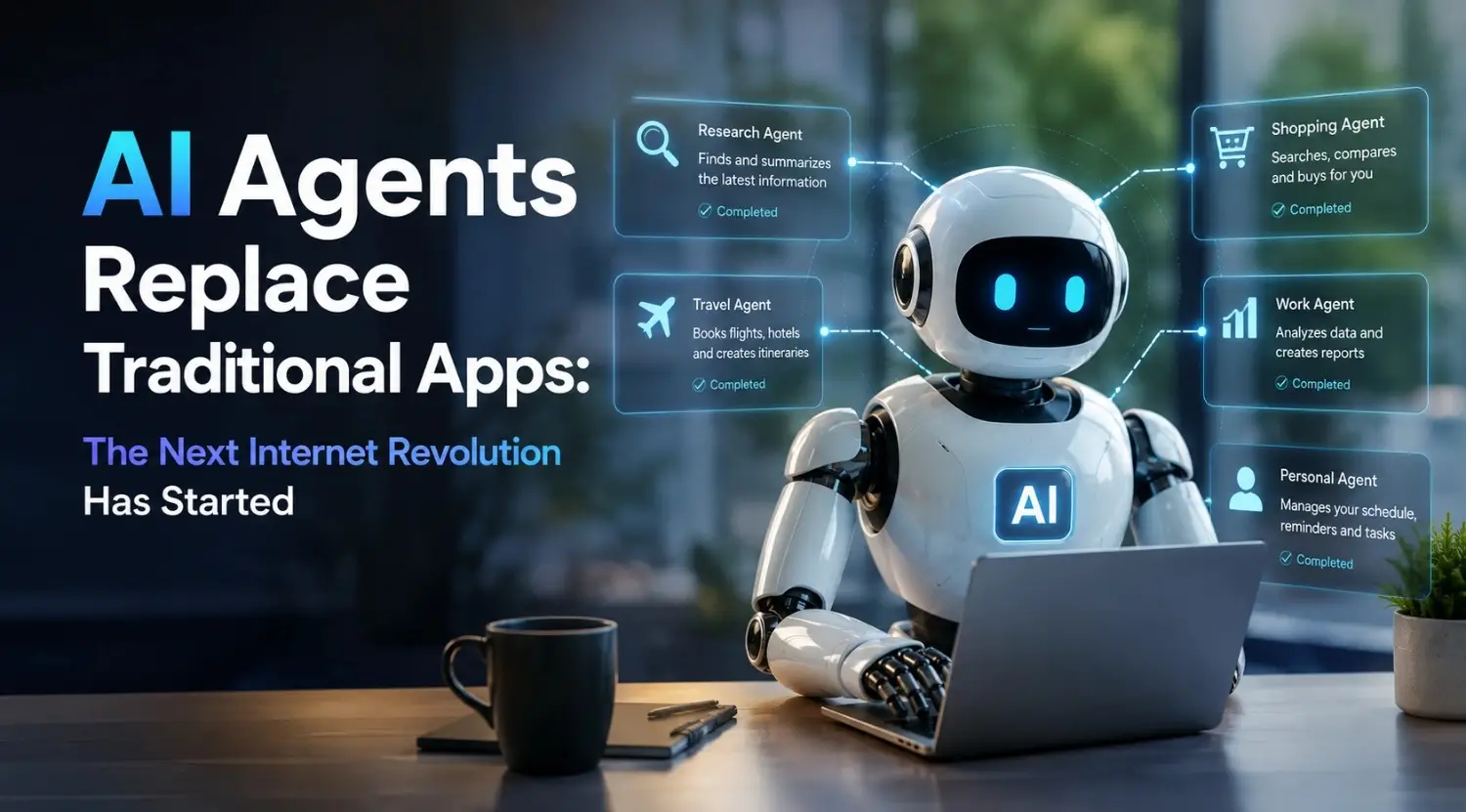
For two decades, the digital world has been organised around apps. We opened an app to message a friend. An app to order food. An app to book a flight. An app to write a document. The app became the doorway to almost everything we did online.
In 2026, that doorway is being torn down.
The next era of the internet is being built around AI agents autonomous systems that don’t just answer questions but plan, execute, communicate, and operate across digital environments on our behalf. Instead of switching between five apps to plan a trip, you tell one agent: “Plan my trip to Tokyo next month, book the flights, reserve a hotel near Shinjuku, and create a daily itinerary based on my food preferences.” It handles the rest.
This is not science fiction. It is happening right now, and it represents the most fundamental shift in how humans interact with technology since the smartphone replaced the desktop.
From Apps You Open to Agents That Act
The simplest way to understand AI agents is to contrast them with what came before.
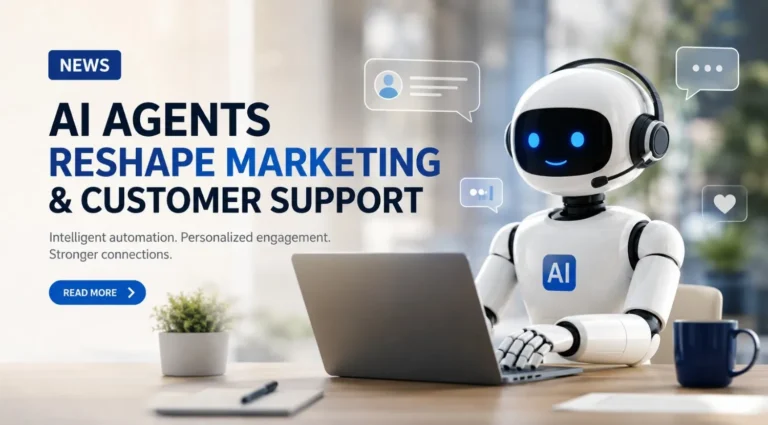
Traditional AI was reactive: you asked, it answered. Useful, but ultimately a more articulate search box. AI agents are different. You state a goal, and the agent figures out the steps, uses tools, coordinates with other agents, and delivers results. An agent doesn’t just summarise a document, it can read the document, draft a reply, schedule a follow-up meeting, and update your CRM, all without you opening any of those applications individually.
This is why 2026 may be remembered as the year AI stopped being something people talked to and became something people worked with. OpenAI has introduced workspace agents in ChatGPT for Business, Enterprise, Edu, and Teacher plans agents designed for repeatable work that can connect tools, automate workflows, run on schedules, and operate in environments like ChatGPT and Slack.
The phrase “digital worker” used to sound like corporate marketing. It is now literal. An AI agent can be given a role, instructions, tools, approved data access, a schedule, and boundaries. It can be told when to stop and ask a human. That makes it less like a software feature and more like a junior team member operating inside a defined process.
The Numbers Behind the Revolution
The scale of the shift is striking. Gartner projects that 40% of enterprise applications will embed AI agents by the end of 2026, up from less than 5% in 2025. The agentic AI market is forecast to surge from roughly $7.8 billion today to over $52 billion by 2030. Gartner also reported a staggering 1,445% surge in multi-agent system inquiries from Q1 2024 to Q2 2025, signalling a structural rethinking of how systems are designed.
One milestone from early 2026 captures the momentum: Anthropic’s Model Context Protocol (MCP) the open standard that lets AI agents connect to tools and data crossed 97 million installs in March 2026. For infrastructure that barely existed eighteen months earlier, this is a remarkable adoption curve.
By 2028, an estimated 38% of organisations are projected to have AI agents embedded directly within human teams. Not alongside teams within them. Blended teams where humans provide judgment, ethics, and creativity while agents handle execution, monitoring, and coordination are quickly becoming the operational norm.
Orchestrated Teams of Specialists
The most important architectural shift of 2026 is that agentic AI is going through its microservices revolution. Just as monolithic applications gave way to distributed service architectures, single all-purpose agents are being replaced by orchestrated teams of specialised agents.
The new model looks like a well-run company. A “puppeteer” orchestrator manages a content agent, a research agent, a data analyst agent, and a reporting agent. Each handles its domain. Each passes outputs to the next. Together they run entire workflows without human hand-holding at every step.
Salesforce and Google Cloud are already building cross-platform agents using the Agent2Agent (A2A) protocol laying the foundation for an open, interoperable agentic enterprise stack. Anthropic’s MCP provides the connective tissue that lets agents talk to tools and data across vendors. These are the early protocols of what may become a new internet, built not around web pages and apps but around interacting autonomous agents.
The Real-World Deployments Already in Production
This isn’t theoretical. Major deployments are already operating at scale:
Salesforce Agentforce is delivering autonomous sales and service agents to enterprise customers.
UPS Orion is handling logistics optimisation with agentic decision-making across the company’s vast delivery network.
Amazon’s Agentic Store is reimagining commerce by allowing autonomous agents to shop, compare, and purchase across catalogues.
Anthropic’s Claude Code has achieved autonomous coding capabilities that compress development cycles by orders of magnitude. In the words of one senior Google engineer, Claude Code “generated what we built last year in an hour.”
Airbnb has adopted Alibaba’s Qwen model for its customer service agent, with CEO Brian Chesky praising it as “fast and cheap.”
ByteDance, Alibaba, DeepSeek, and Moonshot have all debuted or announced agentic AI products in 2026, with Chinese companies actively challenging American firms particularly in open-source agentic models that are accessible to developing nations.
The competitive geography has gone global fast.
Why This Replaces Apps Entirely
The core inefficiency of the app era is that apps are silos. A food delivery app delivers food. A travel app books trips. A finance app manages money. Coordinating across them requires the human user to act as the integration layer manually copying information, switching contexts, and stitching outcomes together.
AI agents collapse this. Because they can use multiple tools, parse multiple data sources, and chain actions across services, they eliminate the need for users to navigate between separate applications. The agent becomes the universal interface. The apps become invisible plumbing underneath.
The mobile landscape reflects this shift architecturally. The industry is pivoting toward what some engineers call “Agentic Native” architecture moving from graphical user interfaces (GUI) to intent-based interfaces (IUI). Users no longer want to tap their way through menus. They want to state a goal and have the system figure out the rest.
Neural Processing Units (NPUs) in flagship 2026 devices are designed specifically to run AI agents efficiently on-device. Small Language Models (SLMs) are being deployed locally to handle sensitive data without sending it to the cloud satisfying privacy regulations and delivering instant responsiveness.
The implication for app developers is profound: the app store as the primary distribution channel may not survive this decade in its current form.
Vibe Coding and the Democratisation of Software
The agentic shift is also rewriting who can build software. By 2026, an estimated 40% of enterprise software is expected to be built using natural language-driven “vibe coding” where prompts guide AI to generate working logic. Business users, not just engineers, are now creating agents tailored to their workflows.
This is the democratisation of AI development. The people who understand how to think clearly about problems and communicate goals precisely have a significant edge in this new era making skills like prompt engineering, workflow design, and clear problem framing genuinely valuable in ways they weren’t before.
The Three-Tier Ecosystem Forming Around Agents
A clear ecosystem structure is emerging:
Tier 1: Hyperscalers providing foundational infrastructure compute, base models, and the heavy AI lifting. AWS, Google Cloud, Microsoft Azure, Nvidia.
Tier 2: Established enterprise software vendors embedding agents into existing platforms Salesforce, SAP, ServiceNow, Microsoft, Oracle.
Tier 3: Agent-native startups building products with agent-first architectures from the ground up. These are the most disruptive players bypassing traditional software paradigms entirely and designing experiences where autonomous agents are the primary interface, not a supplementary feature.
It is the third tier that has the highest probability of producing the next decade’s defining companies.
The Governance Gap: The Shadow Side
Every revolution has a shadow side, and the 2026 agentic boom is no exception. Governance is lagging catastrophically behind capability.
Most Chief Information Security Officers express deep concern about AI agent risks, yet only a handful have implemented mature safeguards. Organisations are deploying agents faster than they can secure them. Unlike traditional software that executes predefined logic, agents make runtime decisions, access sensitive data, and take actions with real business consequences. That changes the security model fundamentally.
Leading organisations are responding by implementing “bounded autonomy” architectures with clear operational limits, human escalation paths for high-stakes decisions, and comprehensive audit trails. More advanced setups deploy “governance agents” that monitor other AI systems for policy violations and “security agents” that detect anomalous agent behaviour. But these practices are still the exception, not the rule.
Specific failure modes are well documented. A travel agent given a goal of “save money” may book a 10-hour layover route instead of the user’s historical preference for direct flights and the mistake may only surface after the non-refundable window closes. Anthropic has also documented Chinese state-affiliated hackers automating cyberattacks using AI agents, while the White House is racing to harness agents for scientific breakthroughs through the Genesis Mission. The same capabilities that drive productivity also lower the cost of harm.
Gartner has gone further, estimating that 40% of today’s agents will not survive to 2027 replaced by superior options as the market corrects and matures.
What This Means for You
For individuals: The way you use technology is about to change profoundly. Within a few years, you may interact primarily with one intelligent system rather than dozens of apps. You’ll describe outcomes, not navigate interfaces. Skills like clear thinking, structured communication, and judgment will become more valuable, not less.
For developers: The opportunity is enormous, but the rules have changed. Building an agent is different from building an app. It requires designing for autonomy, planning for failure modes, building human-in-the-loop checkpoints, and creating interoperability across the agentic stack.
For enterprises: The strategic question is no longer whether to deploy AI agents but how to govern them. The companies that solve governance bounded autonomy, audit trails, escalation paths, security agents will move faster than those still arguing over whether to begin.
For investors: A three-tier ecosystem creates three distinct investment theses. Infrastructure plays favour hyperscalers. Embedded-agent plays favour established enterprise vendors. Agent-native plays favour startups designing from first principles around autonomy.
The Bottom Line
The app era is not ending overnight. Apps will coexist with agents for years, the way websites coexisted with mobile apps for years before the balance shifted. But the trajectory is unmistakable. As Sam Altman predicted, agents are joining the workforce and even sceptics like OpenAI co-founder Andrej Karpathy, who initially dismissed early agents as “agentic slop,” changed their view after working with newer systems like Claude Code.
Every major technology era has changed how humans interact with machines. The keyboard replaced punch cards. The graphical interface replaced the command line. The smartphone replaced desktop-first computing.
AI agents may be the next shift on that scale and it has already started.
The internet is no longer just a place we visit through apps. It is becoming a place where intelligent systems work on our behalf, around the clock, across every digital surface we touch. The companies, professionals, and users who understand this shift early will define what comes next.