
Bengal has always been the crown jewel of Indian opposition politics. For 34 years it belonged to the Left. For the past 15, it has been Mamata Banerjee’s fortress. Today, May 4, 2026 — counting day — is rewriting that story in saffron.
The Bharatiya Janata Party is surging toward a historic victory in West Bengal, leading in approximately 195–196 of 294 assembly constituencies as of the latest Election Commission data. The majority mark stands at 148 seats. The BJP crossed it hours ago and shows no sign of slowing.
This is a massive setback for incumbent Chief Minister Mamata Banerjee-led Trinamool Congress (TMC), which as of now is leading on just 92–95 seats — a catastrophic fall from the 215 seats the party won in 2021.
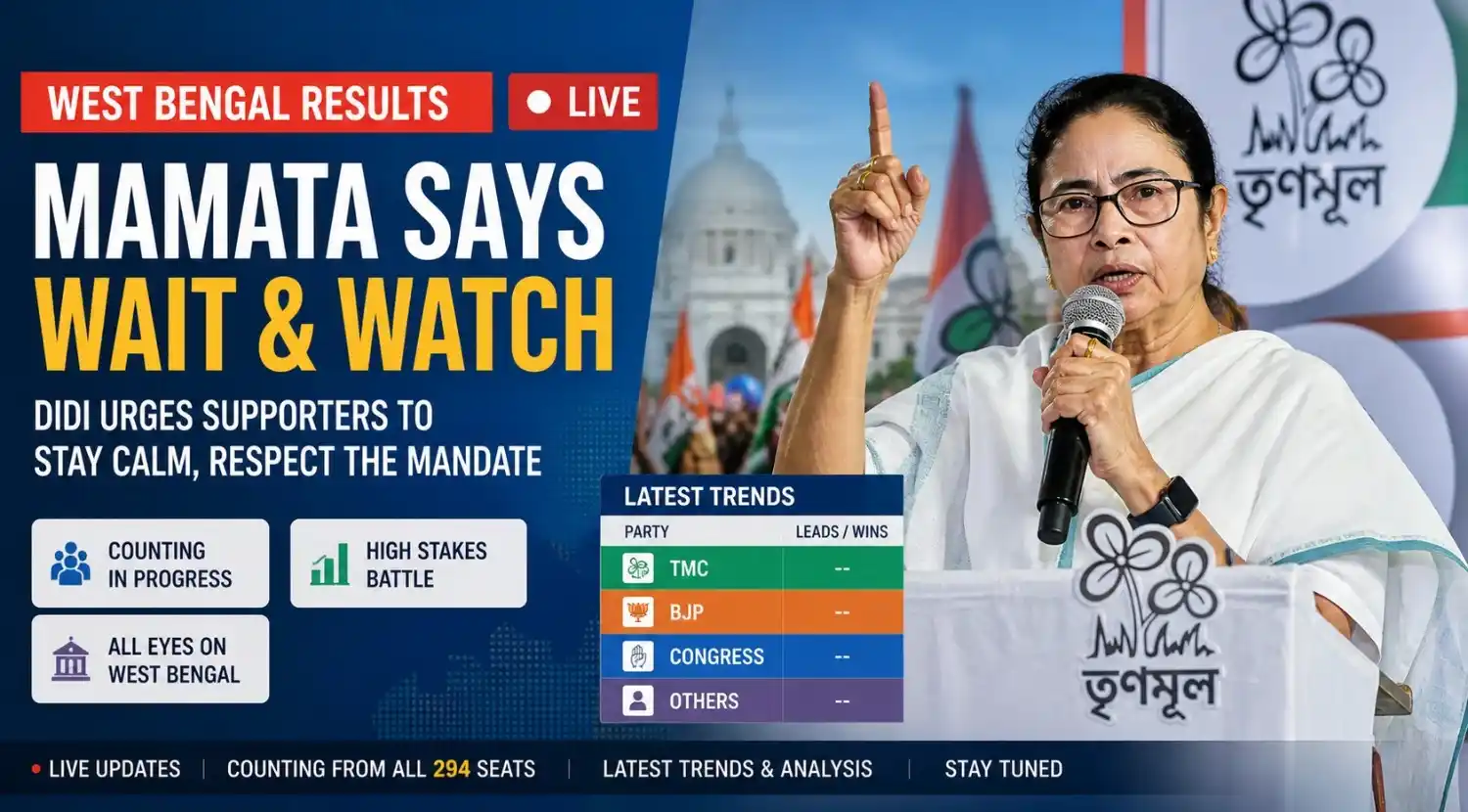
And in a dramatic response that has gripped social media, Mamata Banerjee posted a one-and-a-half minute video on X (formerly Twitter), refusing to concede defeat and asking party workers and supporters to “wait and watch” as counting continues.
West Bengal’s political earthquake is here. Here’s everything you need to know.
Live Seat Tally: The Numbers Right Now
As of the latest Election Commission data, May 4, 2026:
| Party / Alliance | Seats Leading / Won |
|---|---|
| BJP | 195–196 |
| TMC (Trinamool Congress) | 92–95 |
| Left Front + Congress | Remaining |
| Others | Remaining |
Total assembly seats: 294 | Majority mark: 148
The BJP has already surpassed the majority threshold comfortably. Counting continues across 77 counting centres in the state, but the broad direction has been sealed since midday.
Mamata’s Message: “Wait and Watch, We Are Winning”
The political image of the day belongs not to the victors, but to Mamata Banerjee.
Even as early leads indicated a strong BJP surge and projections pointed towards a possible landslide victory, West Bengal Chief Minister Mamata Banerjee urged party workers to remain present at counting centres and stay alert till the final round of counting.
In the video posted on X, the three-time chief minister said 14 to 18 rounds of voting would be held, and urged TMC supporters not to lose hope. She also criticised the Special Intensive Revision (SIR) of electoral rolls and alleged that genuine voters had been removed from the voter list. “I request all counting agents and candidates to remain in strong rooms and not leave their centres,” she said. “I am saying this since yesterday that the BJP votes will be shown first.”
She alleged that attempts could be made to project an early lead to influence perceptions and called the BJP’s early surge a “wicked game plan,” asserting confidence that the final outcome would favour her party.
Earlier in the morning, even before counting began, Banerjee had posted a different message: “Be vigilant. Keep watch. Stay awake at night. File complaints.” She claimed reports of deliberate power cuts and CCTV shutdowns near strong rooms from areas including Hooghly’s Serampore, Nadia’s Krishnanagar, and Burdwan’s Ausgram.
Her tone — combative, suspicious, unbowed — reflects the posture of a leader who has faced down hostile forces before. But the numbers this time are of a different magnitude.
The Bhabanipur Drama: Suvendu vs. Mamata, Round Two
No constituency in Bengal is being watched more closely than Bhabanipur — and for good reason.
BJP’s Suvendu Adhikari contested against Chief Minister Mamata Banerjee from the Bhabanipur seat. According to the second round of counting, Adhikari led by 1,558 votes against the incumbent Chief Minister.
However, by later rounds of counting, Mamata Banerjee had taken a massive lead in Bhabanipur against Suvendu Adhikari — leading by 19,393 votes, according to the Election Commission.
The battle has swung back and forth through the rounds, keeping it one of the most dramatic contests of counting day. Adhikari, an aide-turned-foe of Banerjee, had defeated her in the Nandigram assembly constituency in the 2021 elections, and the party fielded him against the chief minister again this cycle.
Adhikari is also contesting from Nandigram, where he is reportedly leading. The outcome in both seats will shape not just headlines but the political narrative of post-result Bengal.
What Drove the BJP Wave? The Five Forces Behind the Surge
1. Anti-Incumbency After 15 Years
Anti-incumbency after 15 years of AITC rule was noted as a major factor in the contest. Fifteen years is a long time for any government, and Bengal’s TMC had accumulated enough controversy — from the school recruitment scandal to law and order concerns — to energise voters seeking change.
2. The SIR Controversy That Changed Everything
The Special Intensive Revision (SIR) of electoral rolls became the defining flashpoint of this election cycle. The SIR removed around 9 million voters from the rolls in West Bengal, representing about 12% of the electorate. Over six million were categorised as absentee or deceased, while the status of 2.7 million remained pending before tribunals.
The dominance of the SIR narrative had a significant impact on the election campaign. Traditional issues such as unemployment, corruption, industrial stagnation and governance failures took a backseat. The election effectively became a referendum on identity, citizenship, and institutional trust — terrain where the BJP’s messaging on infiltration and Hindu consolidation proved far more potent.
The impact of the SIR was particularly visible in districts like North 24 Parganas, Murshidabad and parts of South Bengal. In several constituencies, the number of deleted names exceeded the victory margins from previous elections, making the outcome highly unpredictable.
3. The BJP’s Campaign Machinery
For the BJP, the election campaign was led by Prime Minister Narendra Modi and Union Home Minister Amit Shah, who repeatedly targeted Banerjee over infiltration from Bangladesh and accused the TMC of looting Bengal. The party promised to usher in a ‘sonar Bangla’ (golden Bengal) for the state.
4. The RG Kar Factor
One of the most emotionally charged candidacies of this election: Ratna Debnath, the BJP candidate from the Panihati assembly constituency and the mother of the RG Kar Medical College rape-murder victim, was leading from the seat by a margin of more than 2,763 votes. Her candidacy turned a symbol of public outrage into a ballot-box moment.
5. A Record Turnout That Favoured the Challenger
A huge and historic voter turnout of about 93% was recorded in the state, surpassing the previous record of 84% in the 2011 assembly election, when the 34-year rule of the Left Front fell to the TMC. The parallel is not lost on observers — the last time Bengal recorded such extraordinary turnout, it ended the ruling party’s era. History appears to have repeated itself.
The BJP’s Journey: From 3 Seats to Near-200 in Eight Years
To understand today’s result, the trajectory matters.
In the 2016 West Bengal Assembly election, the BJP won just 3 seats. In 2021, that rose dramatically to 77 seats — still short of challenging TMC’s majority but a seismic shift. Then came the 2024 Lok Sabha elections, where the BJP won 18 of 42 parliamentary seats in Bengal — a result that signalled the state’s political winds were shifting more decisively than ever.
Today, the BJP appears set to win roughly 195 seats — going from 3 to 77 to ~195 in three electoral cycles. This is one of the most dramatic growth trajectories of any party in any Indian state in the democratic era.
As the saffron party crossed the majority mark of 148 in the state, BJP leader Suvendu Adhikari called it a result of “Hindu consolidation” and slammed Mamata Banerjee-led TMC.
Key Constituencies to Watch
Bhabanipur: The Mamata vs. Suvendu rematch. Numbers have swung dramatically through counting rounds, with Mamata currently holding a significant lead after trailing early.
Nandigram: BJP is leading in Nandigram as well, where Suvendu Adhikari is contesting.
Baharampur: Congress heavyweight Adhir Ranjan Chowdhury is trailing against BJP leader Subrata Maitra by 3,382 votes — a significant blow to one of Bengal Congress’s last remaining prominent voices.
Panihati: The RG Kar mother’s seat — BJP leading, watched as a barometer of public anger over the case.
Diamond Harbour and Magrahat Paschim: These seats drew attention after repolling was ordered in 15 booths just two days before results.
Falta: The only constituency where results won’t be known today. Due to heavy breaching of election procedures and EVM tampering, the whole assembly constituency of Falta was scheduled to be repolled on May 21, with counting and results on May 24.
What the Left and Congress Are Left With
The Left Front, which ruled Bengal for 34 years, and the Congress are picking through the wreckage on the sidelines of today’s results. Their combined tally appears likely to be in the single digits or very low double digits — a continuation of their near-total erasure from Bengal’s political map that began in 2011.
Adhir Ranjan Chowdhury’s likely loss in Baharampur, after returning to the constituency he once dominated, would mark the end of an era for Bengal Congress’s grassroots presence.
The Broader National Picture: INDIA Bloc in Freefall
Today’s results are not just about Bengal. With three Opposition-ruled states at stake — West Bengal, Tamil Nadu, and Kerala — today’s election was crucial for the INDIA bloc, which has been losing ground in states at a steady pace.
If West Bengal confirms a BJP victory at this scale, coupled with a hung assembly in Tamil Nadu and whatever result emerges from Kerala, the Opposition’s position heading into future electoral cycles becomes significantly more precarious.
Prime Minister Narendra Modi is scheduled to go to the BJP headquarters at 6:30 PM today, as the saffron party prepares to celebrate a historic victory in West Bengal.
For the National Democratic Alliance (NDA), Bengal would represent the culmination of a decade-long project to break open what was once India’s most impenetrable Opposition stronghold.
Mamata Banerjee: The End of an Era?
The most profound question hanging over today’s results is personal and political: what happens to Mamata Banerjee?
She has been the defining figure of Bengal politics since 2011. Her welfare schemes — Lakshmi Bhandar, Swasthya Sathi, Kanyashree — have genuinely transformed lives. Her padyatras, her personal connection with voters, her image as a fighter against Centre’s overreach, have all been authentic expressions of a leader who built her base from the ground up.
But today, even as she personally fights to hold her own seat in Bhabanipur, the party she built appears headed for its worst-ever electoral performance.
Banerjee has refused to concede. She has alleged manipulation, questioned institutional integrity, and called on her workers not to abandon their posts at counting centres. Whether this is the defiance of a comeback — as she staged against the Left in 2011 — or the final act of a 15-year political chapter, only the coming days and weeks will make clear.
Conclusion: Bengal Has Spoken — Loudly
A 92.93% voter turnout. Nearly 200 seats for a party that had 3 just eight years ago. A three-time sitting Chief Minister potentially losing her own seat (though she is currently leading). The mother of a rape-murder victim winning as a BJP candidate. A video from Mamata Banerjee saying “wait and watch.”
This is not a routine election result. This is a political transformation of historic proportions.
Whether one views today’s outcome as the fulfilment of democratic aspiration or the culmination of a campaign driven by identity polarisation, no observer can deny the scale of what is happening in West Bengal today. The state that gave India Rabindranath Tagore, Subhas Chandra Bose, and the 34-year Left experiment has once again confounded prediction, defied comfort, and produced a verdict that will shape Indian politics for years to come.
Bengal has voted. Loudly, decisively, and with the kind of turnout that leaves no room for ambiguity.
Follow live updates on the Election Commission of India portal at eci.gov.in