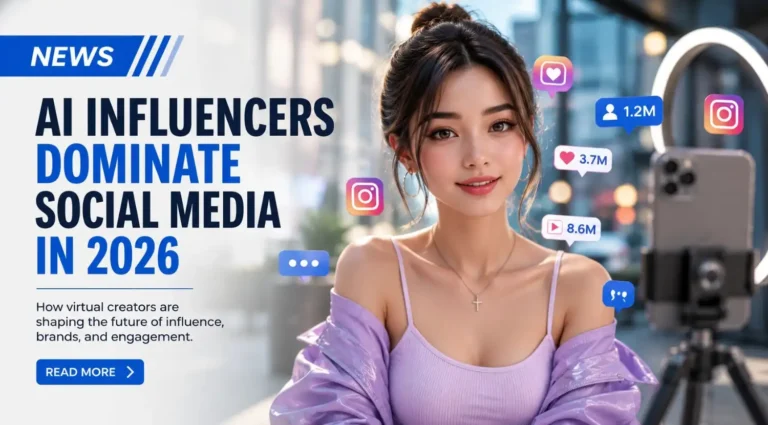
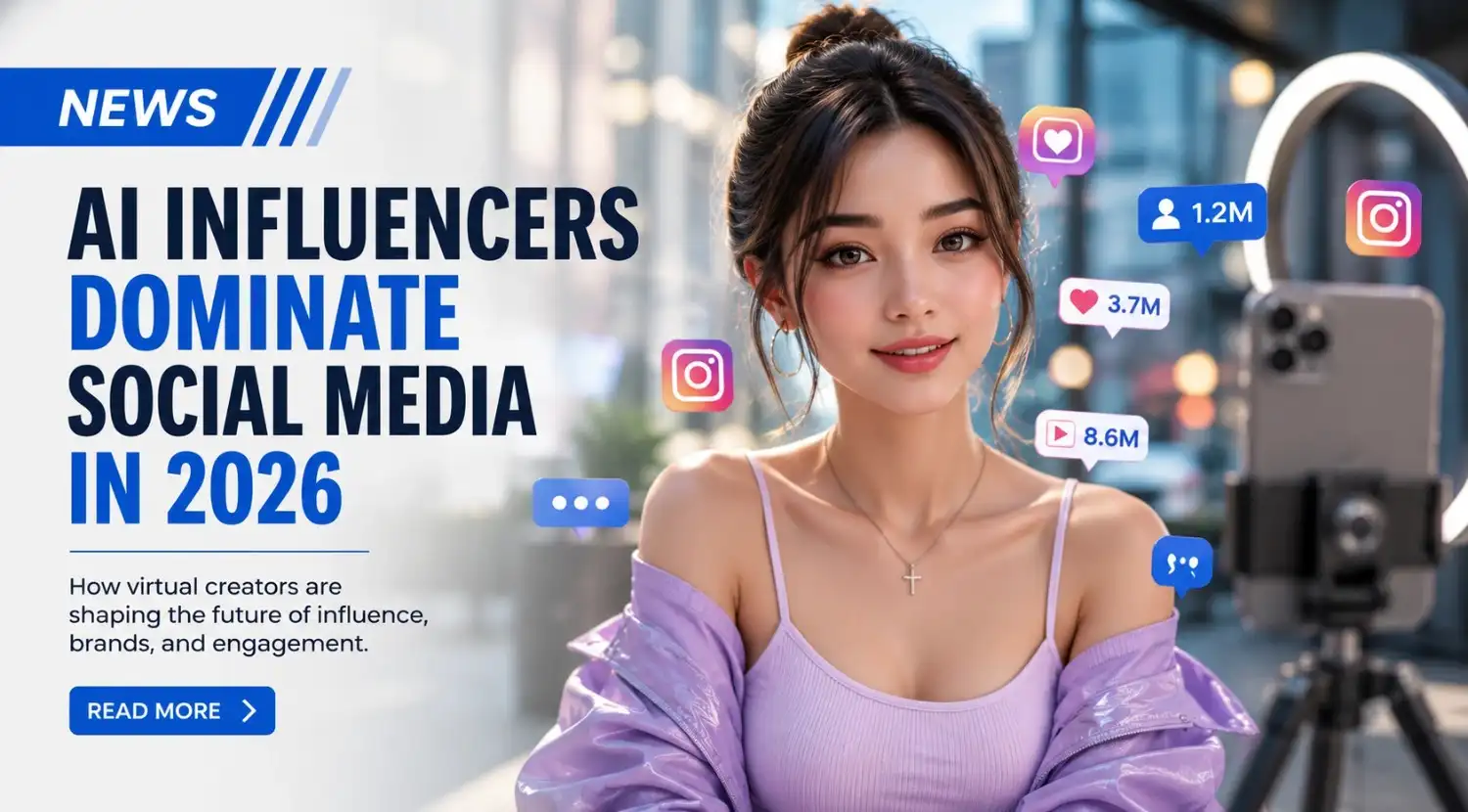
Scroll through Instagram or TikTok in 2026 and you may follow, like, and trust a creator who has never existed. They post selfies from cafés they never visited, model clothes they never wore, attend events they never walked into, and reply to fans they never met. They are AI influencers and they are no longer a curiosity at the edge of social media. They are becoming the main event.
Virtual creators now command millions of followers, sign major brand deals, drive real revenue, and shape online culture without a single human face behind the camera. The question that once sounded like science fiction is now a genuine business question for every marketer, agency, and platform: what happens to social media when the most influential creators aren’t human at all?
Here is a clear-eyed look at how AI influencers came to dominate 2026, why brands are pouring money into them, and the uncomfortable questions the trend raises.
What Exactly Are AI Influencers?
AI influencers also called virtual influencers or virtual creators are computer-generated characters built with a mix of artificial intelligence, 3D design, and animation tools. Most are not based on real people. Instead, they are designed from scratch with unique faces, voices, personalities, backstories, and aesthetics, each engineered to appeal to a specific audience.
They live on the same platforms as everyone else Instagram, TikTok, YouTube posting photos, short videos, and stories exactly like human content creators. The difference is that everything about them, from their morning routine to their political opinions, is authored by a team or an algorithm.
What separates the 2026 generation from earlier virtual influencers is intelligence and adaptability. Early virtual influencers were essentially elaborate CGI puppets. Today’s are increasingly powered by generative AI, allowing them to produce content faster, respond to fans, adapt to trends in real time, and evolve their personalities over time.
The Pioneers: From Lil Miquela to a Crowded Field
The story of virtual influencers begins with Lil Miquela (Miquela Sousa), who launched on Instagram in 2016 as a CGI avatar and quickly became a pioneer of the space. She was one of the first virtual influencers to cross into mainstream brand and culture territory, blending luxury fashion, music, and activism. Her feed reads like that of a real Gen Z creator casual selfies, social justice messaging, collaborations, behind-the-scenes moments and she has worked with brands like Prada and Calvin Klein.
In the past year alone, Lil Miquela reportedly partnered with 91 brands, reached over 9.9 million users, and generated around $235,000 in estimated media value. She still commands over 2 million followers.
But in 2026, she is no longer alone. The field has exploded:
Aitana López is a Spanish AI model with a strong presence in fashion and lifestyle communities created by an agency specifically to give it full control over a “creator” who never ages, never tires, and never goes off-message.
Imma is a pink-haired Japanese digital influencer featured in Vogue Japan, with collaborations including IKEA Japan and Porsche. Her content shows her posing at dinner, visiting laundrettes, and “attending” events small, human, everyday moments that make her feel real.
Lu do Magalu, the virtual face of Brazilian retailer Magazine Luiza, is one of the most-followed virtual influencers in the world.
Guggimon, created by Superplastic, breaks the mould entirely an edgy, mischievous cartoon rabbit rather than a human-looking persona, intersecting art, fashion, and gaming with collaborations spanning Fortnite, Poppi, and Cheetos.
Kai Wing serves as Adobe’s AI Creator Ambassador, while artists like APOKI a virtual performer with whimsical, futuristic music content show that virtual creators are moving into music and entertainment, not just fashion.
The list of names grows every quarter. The space that one CGI avatar pioneered now hosts hundreds of competing digital personalities.
Why Brands Are Betting Big
The shift is not driven by novelty. It is driven by economics, and the numbers are striking.
The AI virtual influencer market is projected to reach roughly $45.88 billion in 2026. According to industry data, virtual influencers can deliver around 30% higher engagement than human creators reported at 5.8% versus 2.3% alongside roughly 50% lower costs and 98% faster content production compared to human-only workflows.
For brands, the appeal comes down to four powerful advantages:
Total control. A virtual influencer never says the wrong thing at a party, never posts a controversial opinion overnight, and never becomes a PR liability. Every word and image is approved before it goes out. For risk-averse brands, this is enormously attractive.
Infinite scalability. A virtual creator can be placed in any location, any outfit, any scenario instantly no flights, no shoots, no scheduling. They can promote a product in Paris and Tokyo on the same day without leaving a hard drive.
Consistency. Virtual influencers never age, never burn out, and never drift off-brand. The persona that signed the contract is the persona that delivers, year after year.
Cost and speed. With AI tools handling content generation, brands can produce campaigns at a fraction of the time and budget of traditional shoots.
There is also a deeper market force at work: a reported 100-to-1 content demand gap and widespread creator burnout among human influencers. Audiences want more content than human creators can sustainably produce. Virtual creators fill that gap without exhaustion.
The Tools Powering the Boom
Behind every AI influencer is a growing ecosystem of platforms and agencies. Tools like Sozee, Influencer Studio, HeyGen, Argil, SynthLife, APOB, and Influencer Farm now let brands and agencies generate, manage, and scale virtual personalities some offering setups as simple as uploading three photos to spin up a hyper-realistic digital creator.
The crucial competitive factor among these platforms is visual consistency: keeping a character’s face, body, and style identical across thousands of generated images and videos. The agencies that solve consistency at scale are the ones winning brand contracts.
This tooling boom means creating a virtual influencer is no longer the exclusive domain of well-funded studios. Increasingly, any agency or any ambitious individual can launch one.
Why Audiences Actually Follow Them
It would be easy to assume audiences reject virtual creators once they realise they aren’t real. The data suggests otherwise. AI influencers appeal strongly to younger audiences who value digital-first, experimental content. For Gen Z and Gen Alpha generations raised on gaming avatars, VTubers, and digital identities a virtual creator is not uncanny. It is native.
Part of the appeal is the content itself. Virtual creators can do things humans cannot: exist in surreal environments, defy physics, shift aesthetics instantly, and tell serialised stories across posts. APOKI’s magical music videos and Guggimon’s cartoon chaos are not imitations of human content they are something genuinely new.
There is also a parasocial dimension. Fans know these characters are constructed, yet still form attachments to their personalities and storylines, much as they do with fictional characters in film and games.
The Uncomfortable Questions
For all the momentum, the rise of AI influencers raises serious ethical and practical concerns that the industry has not fully resolved.
Authenticity and deception. Influencer marketing was built on a promise of relatability a real person genuinely recommending a product. A virtual influencer cannot genuinely use anything. When a digital character “loves” a moisturiser, the recommendation is pure script. Critics argue this hollows out the trust that made influencer marketing work in the first place.
Disclosure and labelling. Regulators and social platforms are moving toward clearer labelling and disclosure requirements for synthetic media. Audiences arguably have a right to know whether the creator they follow is human. Brands using AI influencers will increasingly need to disclose this clearly and those that don’t may face both regulatory and reputational consequences.
Unrealistic standards. Virtual influencers are often designed to be flawless perfect skin, perfect proportions, perfect lives. Layering algorithmically perfected digital humans on top of an already image-pressured social media environment raises real concerns about body image and self-esteem, particularly among young audiences.
Emotional connection. Even supporters acknowledge that virtual creators struggle to replicate the genuine emotional depth and lived experience of human influencers. A virtual creator can describe grief, joy, or struggle but it has experienced none of them.
Economic displacement. As brand budgets shift toward cheaper, controllable virtual creators, human influencers especially smaller creators may find it harder to compete.
The Realistic Future: Hybrid, Not Replacement
Despite the headline “social media without humans,” the most likely future is not full replacement. It is hybridisation.
Industry forecasts point toward campaigns that blend the flexibility, scalability, and control of AI influencers with the relatability and emotional depth of human creators. The next phase is expected to feature hybrid collaborations virtual influencers working alongside human creators and real-time adaptive personalities that respond live, personalise content for individual users, and evolve over time.
Deeper personalisation is also coming. AI personas may eventually tailor their content, tone, and even appearance to individual audience segments based on data a level of customisation no human creator could ever match.
In other words, AI influencers are unlikely to make human creators obsolete. But they are permanently changing what the creator economy looks like, who competes in it, and how brands think about the word “influence.”
The Bottom Line
So is social media now “without humans”? Not quite but the line has blurred further than most people realise. AI influencers and virtual creators are no longer a gimmick. With a market heading toward $46 billion, engagement rates that outperform humans, and a roster of digital personalities signing real brand deals, they have become a structural part of how social media works in 2026.
For brands, the opportunity is real: scale, control, speed, and cost savings that human-only campaigns cannot match. But so is the responsibility to disclose clearly, to avoid deceptive practices, and to think hard about the cultural and psychological effects of filling feeds with flawless digital humans.
The creators of the future may be code. But the choices about how honestly and responsibly they are used still belong, firmly, to humans. That is the part of social media that cannot and should not be automated.