The way we work has changed dramatically over the past few years. What used to be a clear-cut decision—land a stable job, climb the corporate ladder, retire with a pension—has now become one of the most debated career questions of our time. Should you stick with a traditional full-time job, or take the leap into freelancing? In 2025, with remote work, AI tools, and the gig economy reshaping the professional landscape, this question is more relevant than ever.
The truth is, there’s no universal “right answer.” The better choice depends on your personality, financial situation, life goals, and risk tolerance. In this article, we’ll break down the real pros and cons of both paths, dispel some popular myths, and help you figure out which one actually suits you in 2025.
The Changing Nature of Work in 2025
Before we compare the two, it’s worth understanding the context. The post-pandemic world accelerated remote work adoption, and now hybrid setups are the norm for most knowledge workers. At the same time, platforms like Upwork, Fiverr, Toptal, and LinkedIn have made it easier than ever to find freelance clients globally. AI tools have boosted productivity for solo professionals, allowing one person to do the work of an entire small team.
Companies are also rethinking their hiring strategies. Many now prefer hiring contractors and freelancers for specialized projects instead of expanding full-time headcount. This shift has created massive opportunities for skilled freelancers, but it has also introduced new uncertainties for traditional employees.
In short, both paths look very different today than they did even five years ago.
What Does a Full-Time Job Offer in 2025?
Let’s start with the path most people are familiar with—the traditional 9-to-5 (or these days, often 10-to-7) full-time job.
Stability and Predictable Income
The biggest advantage of a full-time job is financial stability. You know exactly how much money will hit your bank account every month, which makes budgeting, EMIs, and long-term planning much easier. For people with family responsibilities or financial commitments, this predictability is invaluable.
Benefits Beyond Salary
Full-time employment typically comes with health insurance, provident fund contributions, paid leave, gratuity, bonuses, and sometimes stock options. These benefits often add 20-30% to your effective compensation, but they’re easy to overlook because they don’t show up directly in your bank account.
Career Growth and Mentorship
Working in an established organization gives you access to mentors, structured learning, and a clear career progression. You can observe how senior leaders make decisions, build cross-functional skills, and earn promotions over time. For early-career professionals, this exposure is often more valuable than the paycheck itself.
Reduced Personal Liability
When you’re an employee, you don’t have to worry about taxes (mostly handled by your employer), client acquisition, contracts, or chasing payments. Your job is to do your work well, and someone else handles the business side.
The Downsides
However, full-time jobs aren’t without drawbacks. Your income is capped by salary structures and annual hikes. You have limited control over your schedule, your projects, and even your colleagues. Office politics, micromanagement, long commutes, and rigid hierarchies can drain your motivation. And perhaps most importantly, layoffs in 2024 and 2025 have shown that “job security” is more of a comforting illusion than a guarantee.
What Does Freelancing Offer in 2025?
Now let’s look at the other side. Freelancing has evolved from a side hustle into a legitimate full-time career path for millions worldwide.
Freedom and Flexibility
Freelancers control their schedule, workload, and work environment. Want to work from a beach in Goa for a month? You can. Prefer working at midnight? No one’s stopping you. This level of autonomy is something most full-time employees can only dream of.
Unlimited Income Potential
Unlike salaried employees, freelancers can scale their income significantly by taking on more clients, raising rates as they gain experience, and offering premium services. Top freelancers in fields like software development, design, marketing, and consulting often out-earn senior corporate professionals by a wide margin.
Diverse Experience
Freelancers work with multiple clients across industries, which builds a versatile skill set quickly. In two years of freelancing, you might work with startups, multinational companies, NGOs, and entrepreneurs—gaining exposure that would take a decade in a single corporate role.
Being Your Own Boss
There’s no manager breathing down your neck, no office politics, and no forced 9-hour workdays even when your tasks are done. You decide who to work with and when to walk away from a toxic client.
The Reality Check
But freelancing isn’t all sunshine. Income is unpredictable, especially in the first 1-2 years. Some months you’ll earn handsomely; other months might be quiet. You’re responsible for your own health insurance, taxes, retirement savings, and equipment. Client acquisition can feel exhausting, and chasing payments is an unfortunate reality many freelancers face.
There’s also the loneliness factor. Working alone for months can take a toll on your mental health if you’re someone who thrives on social interaction.
Head-to-Head Comparison: Key Factors to Consider
Let’s compare both paths across the factors that matter most.
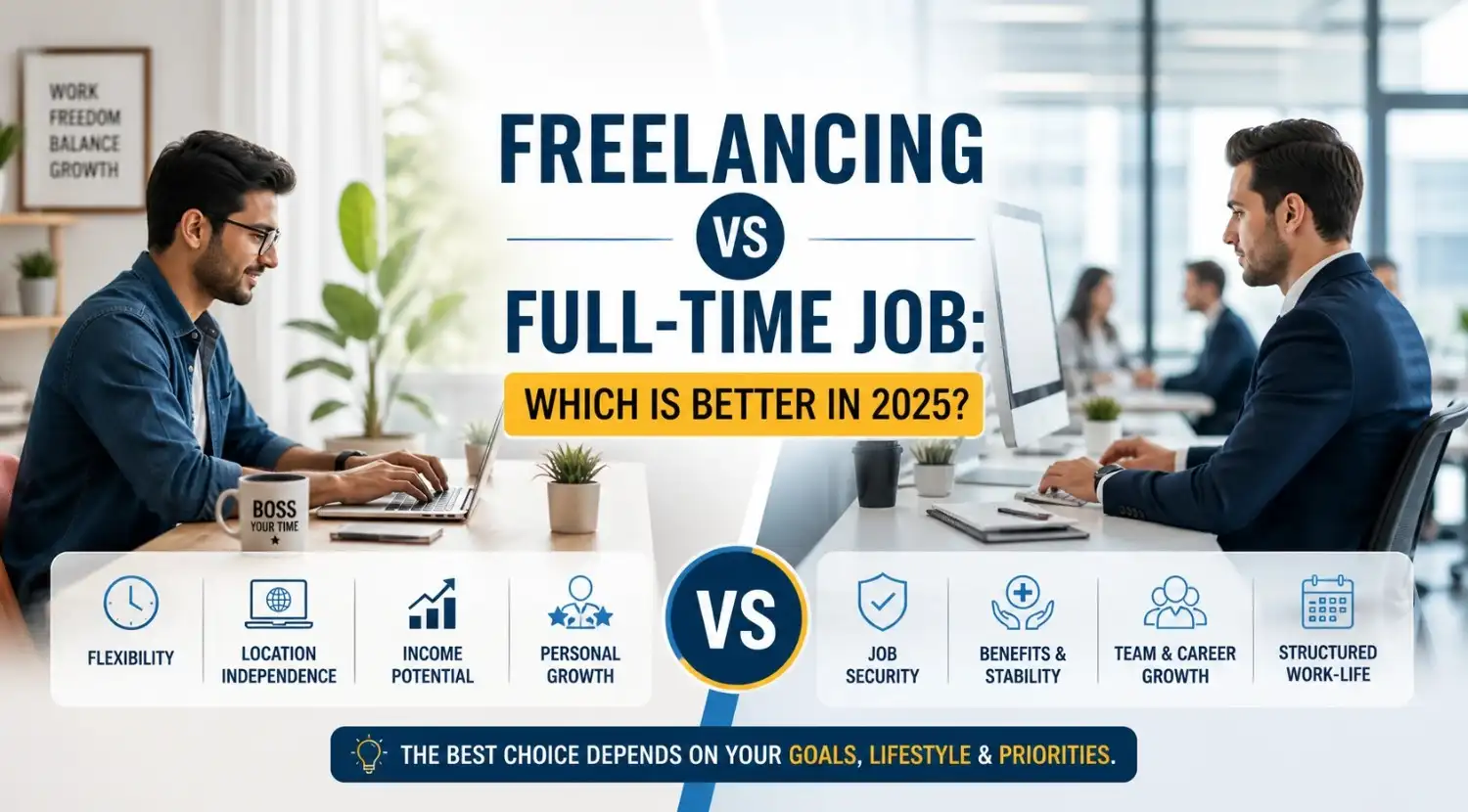
Income predictability: Full-time jobs win clearly, especially in the first few years.
Earning ceiling: Freelancing wins. Once established, freelancers can earn 2-3x more than employees with similar skills.
Work-life balance: It depends. A good freelancer with strong boundaries beats most full-time roles. But a disorganized freelancer often ends up working more hours than employees.
Skill development: Freelancing builds breadth quickly; full-time jobs build depth in specific domains. Both have value depending on your goals.
Job security: Neither is truly secure in 2025. However, freelancers with multiple clients are often more resilient than employees who depend on a single employer.
Benefits and safety nets: Full-time jobs win here. PF, gratuity, health insurance, and paid leaves are real financial cushions.
Taxation and admin: Full-time jobs are simpler. Freelancers in India deal with GST registration (above certain thresholds), advance tax payments, and self-managed bookkeeping.
Mental health: Mixed. Full-time jobs offer structure and social interaction but can cause burnout from politics. Freelancing offers freedom but can lead to isolation and anxiety from income volatility.
Who Should Choose a Full-Time Job?
A full-time job is the better choice if:
- You’re early in your career and need mentorship and structured learning
- You have major financial commitments like home loans or children’s education
- You value stability over flexibility
- You’re risk-averse by nature
- You enjoy collaborative team environments
- Your industry requires institutional credibility (e.g., medicine, law, finance)
There’s no shame in choosing stability. In fact, many financially successful people chose the corporate path and built wealth through disciplined investing rather than entrepreneurship.
Who Should Choose Freelancing?
Freelancing might be the better path if:
- You have a marketable skill that’s in demand
- You’re self-motivated and disciplined
- You can handle financial uncertainty for at least 6-12 months
- You crave autonomy and hate micromanagement
- You’re comfortable with self-promotion and networking
- You have some financial cushion to manage lean months
Freelancing rewards proactive, organized people. If you struggle with self-discipline or need external structure to be productive, full-time work may suit you better—at least for now.
The Hybrid Path: A Smart Middle Ground
Here’s something most articles won’t tell you: you don’t have to choose one or the other. Many professionals in 2025 are blending both worlds.
Start with a full-time job to build skills, network, and savings. Take on small freelance projects on the side (where allowed by your contract). Once your freelance income consistently matches or exceeds your salary for 6+ months, consider going full-time independent. This bridge approach reduces risk and gives you the best of both worlds.
Some even build “portfolio careers”—a part-time consulting role, a few retainer clients, and personal projects. This model offers stability, variety, and freedom simultaneously.
Final Verdict: Which Is Better in 2025?
There’s no objectively “better” option—only what’s better for you right now. Full-time jobs offer security, structure, and benefits, making them ideal for early-career professionals, people with families, and those who value predictability. Freelancing offers freedom, unlimited income potential, and skill diversity, making it ideal for self-driven professionals with marketable skills and some financial cushion.
The smartest move in 2025 isn’t to pick a side—it’s to build skills and a personal brand that work in both worlds. Whether you stay in a job, freelance full-time, or build a hybrid career, the most important investment is in your own capabilities. The job market will keep changing, but skilled, adaptable professionals will always thrive.
So before you make a decision, ask yourself: what kind of life do I actually want to live? The answer to that question will guide you to the right path.