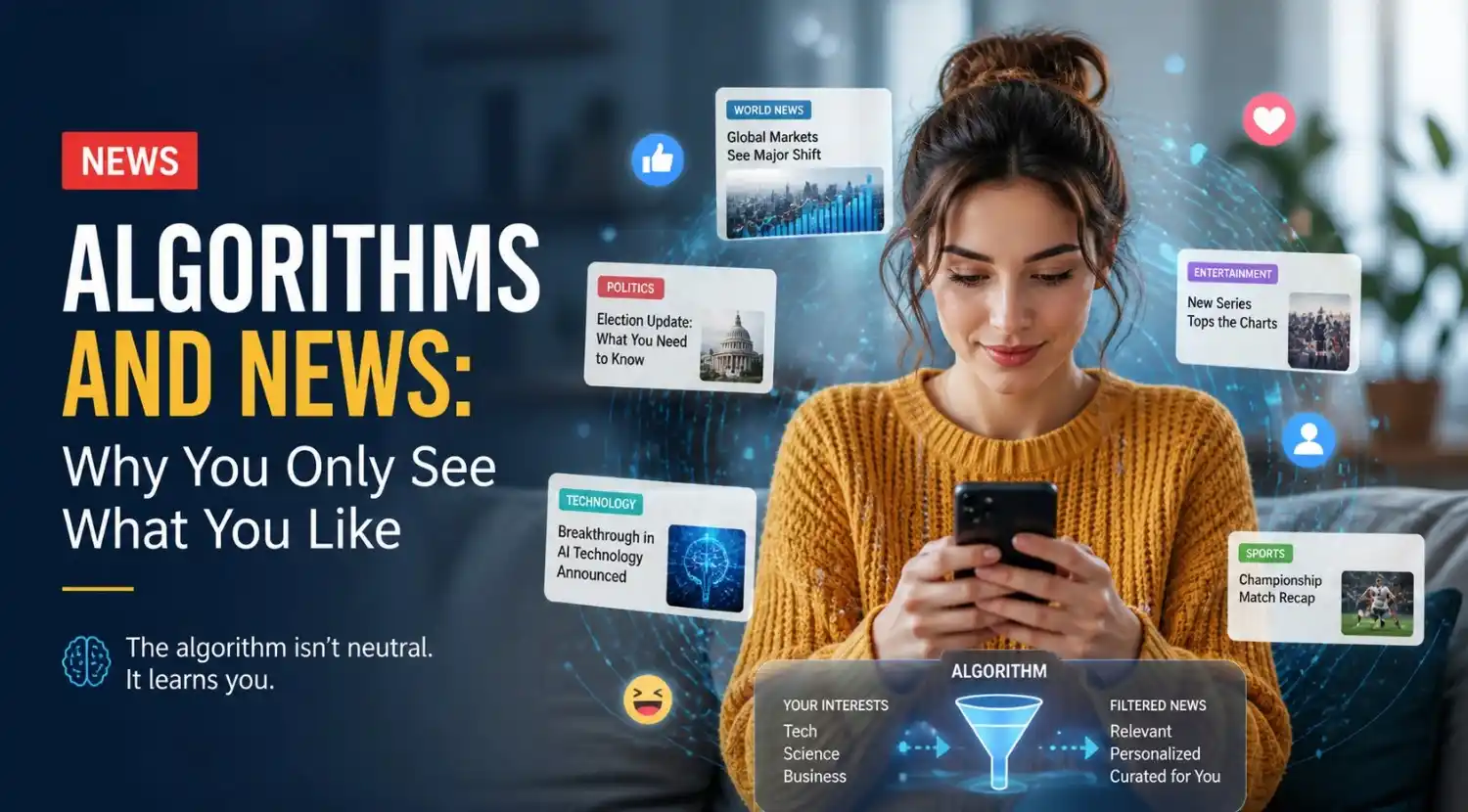
Have you ever wondered why your news feed seems to perfectly match your views, your interests, and even your moods? Why two people can open the same app at the same time and see completely different versions of “what’s happening in the world”? It’s not a coincidence. It’s not even a conspiracy. It’s an algorithm—working exactly as designed—and it’s quietly reshaping how billions of people understand reality.
In 2025, most of us no longer choose our news; the algorithm chooses it for us. From Instagram and YouTube to Google News and X, invisible code decides what stories appear in your feed, what voices get amplified, and what perspectives quietly disappear from view. Over time, this creates something psychologists call a “filter bubble”—a personalized information environment where you mostly see content that confirms what you already believe.
This article unpacks how news algorithms actually work, why they show you only what you want to see, what this is doing to public discourse, and how you can take back some control over your information diet.
How News Algorithms Actually Work
To understand the problem, you first need to understand the goal of these algorithms. Every major platform—whether it’s Facebook, YouTube, Instagram, TikTok, X, or even Google—runs on advertising revenue. The longer you stay on the platform, the more ads they can show you, and the more money they make. Their algorithms aren’t designed to inform you, educate you, or even entertain you in a healthy way. They’re designed to maximize engagement.
Engagement is measured in clicks, watch time, likes, comments, shares, and how long you stop to look at something while scrolling. The algorithm constantly studies your behavior—what you tap, what you ignore, what makes you pause, what you watch till the end—and then serves you more of whatever keeps you hooked.
This is where the problem begins. The content that drives the most engagement isn’t always the most accurate or important. It’s often the most emotionally charged—outrage-inducing political takes, alarming headlines, viral controversies, and content that confirms what you already believe. Slow, balanced, nuanced journalism rarely competes with a sensational hot take. So over time, the algorithm naturally pushes you toward more emotional, more polarizing, and more agreeable content—because that’s what keeps you scrolling.
The Birth of the Filter Bubble
The term “filter bubble” was coined by author Eli Pariser to describe what happens when algorithms personalize your information so thoroughly that you stop seeing perspectives outside your worldview. Imagine standing in a room where the walls only show you opinions you already agree with, news stories that confirm your beliefs, and voices that flatter your tribe. That’s roughly what your social media feed becomes after a few months of algorithmic curation.
The trouble is that you don’t realize it’s happening. Your feed feels normal. It feels like reality. You assume that if something important were going on, you’d know. But you’re only seeing a tiny, curated slice of what’s actually happening, filtered through your own biases and engagement patterns.
Two friends with different political leanings can use the same news app and end up with completely opposite understandings of major events—each genuinely believing they’re well-informed, each unable to understand how the other could be so wrong. They’re not stupid. They’re just trapped in different bubbles.
Why This Is Especially Powerful With News
Personalization in entertainment is mostly harmless. If Netflix recommends you only romantic comedies because that’s what you watch, the worst case is you miss a few good thrillers. But personalization in news has far more serious consequences.
News shapes how you see the world, your country, your government, and other people. When your news feed is filtered to align with your existing views, several things happen.
You become more confident in your opinions, because every story you see seems to confirm them. You become more dismissive of opposing views, because you rarely encounter them in their strongest form. You become more emotionally reactive, because algorithms reward content that triggers strong feelings. And you become more disconnected from people outside your bubble, because you literally don’t see the same world they do.
Over time, this distorts not just your opinions but your sense of what’s normal, what’s important, and what’s true. It also makes productive conversations across political or cultural divides much harder, because you’re not just disagreeing on solutions—you’re disagreeing on basic facts.
The Engagement Trap
One of the most uncomfortable truths about algorithmic news is that it exploits the worst tendencies of human psychology.
Our brains evolved to pay close attention to threats, conflicts, and outrage. In ancient times, this kept us alive. In the digital age, it makes us perfect targets for content that triggers fear, anger, or moral outrage. Studies have repeatedly shown that emotionally charged content—especially negative emotions—spreads far faster and farther than calm, balanced reporting.
Algorithms learned this years ago. They don’t decide that outrage is good; they just notice that outrage drives engagement, so they show you more of it. The result is a steady diet of inflammatory headlines, polarizing takes, and emotionally manipulative content—all designed to keep you scrolling, not to keep you informed.
This explains why social media often feels exhausting. You scroll for 30 minutes and come away anxious, angry, or hopeless about the world, even when you’ve consumed mostly news. The algorithm isn’t broken. It’s working exactly as designed. The problem is that it’s optimized for engagement, not for your wellbeing or for an informed public.
The Echo Chamber Effect
Filter bubbles often combine with another phenomenon called the echo chamber. Filter bubbles are about what algorithms show you; echo chambers are about who you choose to follow and engage with.
Most of us follow people who think like us, share our values, and reinforce our worldview. The algorithm then amplifies posts from those people, plus content the platform predicts we’ll agree with. The result is an environment where the same ideas bounce back and forth, getting louder and more extreme over time, with very little exposure to good-faith disagreement.
In an echo chamber, you stop hearing the strongest version of the other side’s argument. You only hear caricatures of it, usually mocked or attacked by people in your bubble. This makes you increasingly convinced that everyone who disagrees with you must be uninformed, malicious, or stupid. They probably feel exactly the same way about you—because they’re trapped in their own echo chamber.
This dynamic is one of the biggest drivers of political polarization globally. It’s not that people have become more extreme as individuals; it’s that their information environments have become more extreme.
Algorithmic News and Misinformation
Algorithms don’t just create filter bubbles—they actively help misinformation spread. Sensational fake news often outperforms accurate reporting because it’s designed to trigger emotional reactions. By the time fact-checkers correct a viral falsehood, it has already been seen by millions, while the correction reaches a tiny fraction of that audience.
Worse, once you engage with misinformation, the algorithm assumes you’re interested in similar content. A single click on a conspiracy video can pull your feed in directions that take weeks to undo. Many people who fall down rabbit holes of extremism, health misinformation, or financial scams report that it started with a single recommended video that the algorithm kept building on.
Platforms have introduced fact-checking, warnings, and demotion of false content, but these efforts are limited. The fundamental incentive—maximize engagement—remains in conflict with the goal of accurate, healthy information.
The Illusion of Choice
Many people believe that because they “chose” to use a specific app, follow specific accounts, or subscribe to specific newsletters, their information environment reflects their preferences. In reality, your choices are heavily shaped by what the algorithm shows you in the first place.
You don’t see all the great journalism out there—you see what gets surfaced to you. You don’t follow all the smart people in your field—you follow those the algorithm recommends. You don’t form opinions in a vacuum—you form them after weeks of exposure to a curated stream of content selected to keep you engaged.
This is what makes algorithmic personalization so subtle and so powerful. It doesn’t force anything on you. It just nudges, rewards, and shapes your options in ways you barely notice—until your worldview has quietly shifted without you realizing it.
How to Break Out of Your Filter Bubble
The good news is that you’re not powerless. With awareness and effort, you can reclaim control of your news consumption.
Start by diversifying your sources. Don’t rely on a single platform, app, or news channel. Read directly from a few reputable news websites with different editorial perspectives. Subscribe to newsletters from journalists you trust, ideally including some you don’t always agree with.
Follow people across the political and cultural spectrum, even if it’s uncomfortable. The goal isn’t to agree with them—it’s to understand how they see the world. Read or watch them in their original words, not through critics in your bubble.
Use chronological feeds where possible. On platforms that allow it, switch from algorithmic feeds to chronological ones. This reduces the algorithm’s grip on what you see.
Be skeptical of emotionally charged content. If something makes you instantly furious or terrified, slow down before sharing. The most viral content is often the least accurate. Cross-check important claims with at least two reputable sources.
Take breaks. Regular periods of disconnection—a day off social media each week, or a few-day detox every few months—reset your perspective and break the engagement trap.
Read long-form journalism. Books, magazine articles, and in-depth investigations escape the dopamine-driven dynamics of social feeds and offer the depth that algorithmic news usually lacks.
Talk to real people. Conversations with friends, family, neighbors, and colleagues across different backgrounds remind you that the world is much more varied than your feed suggests.
What Platforms and Regulators Could Do
Individual action helps, but the deeper problems require systemic solutions. Some governments are now exploring regulations to make algorithms more transparent, give users more control over what they see, and reduce the spread of harmful content.
Platforms could offer easier ways to switch off personalization, label algorithmic recommendations clearly, and prioritize quality journalism in their feeds. A few have started experimenting with these features, but progress has been slow because their business models depend on engagement.
The conversation about algorithmic accountability is just beginning. As more people understand how these systems shape public discourse, pressure for change will grow.
Final Thoughts
Algorithms aren’t evil, and personalization isn’t inherently bad. The problem is that the systems shaping our news today are optimized for engagement, not truth, balance, or wellbeing. The result is a world where each of us increasingly lives inside a custom-built information bubble, convinced that what we see is reality.
Recognizing this is the first step. Once you understand that your feed is curated, not neutral, you can start making conscious choices about what you consume, who you listen to, and how much trust you place in any single source.
You don’t have to abandon your apps or unfollow everyone. You just have to remember, every time you scroll, that you’re not seeing the world—you’re seeing what someone else’s code has decided you’ll engage with. The more clearly you see that, the more freedom you have to seek out the broader, messier, more interesting truth that lives outside your bubble.