
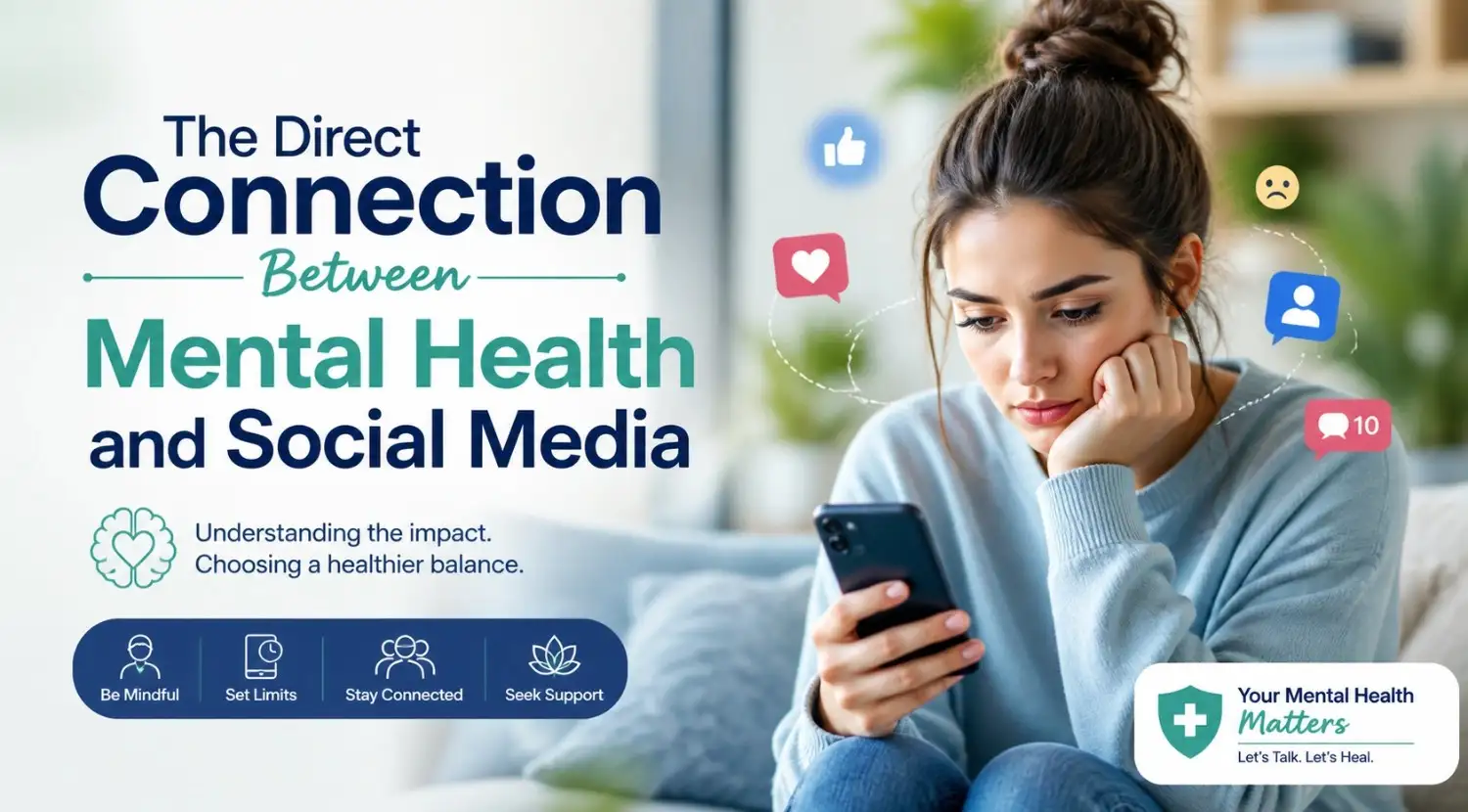
Scroll. Like. Compare. Refresh. Repeat. If this sounds like your daily routine, you’re not alone. Social media has woven itself so deeply into our lives that most of us check our phones within minutes of waking up and scroll right before falling asleep. But while these platforms keep us connected, entertained, and informed, a growing body of research is making one thing clear: there’s a direct, measurable link between social media use and our mental health.
This isn’t about demonizing technology or telling you to delete every app on your phone. It’s about understanding what’s actually happening to your brain, your emotions, and your sense of self when you spend hours each day on these platforms—and what you can do to protect your mental wellbeing without going completely offline.
How Social Media Affects the Brain
To understand the mental health connection, we need to start with what social media does to your brain on a chemical level.
Every time you receive a like, comment, or notification, your brain releases a small hit of dopamine—the same neurotransmitter associated with pleasure, motivation, and reward. This is the same chemical released when you eat your favorite food, win a game, or receive good news. The problem is that social media platforms are specifically engineered to trigger these dopamine responses repeatedly, creating a cycle that mimics behavioral addiction.
Over time, your brain starts craving these tiny rewards. You pick up your phone without realizing it. You feel anxious when you can’t check notifications. You find it harder to focus on tasks that don’t offer instant gratification. This isn’t a character flaw—it’s neuroscience working exactly as the platforms intended.
The Comparison Trap
One of the most damaging psychological effects of social media is the constant comparison it invites. You’re not just looking at your friend’s vacation photos; you’re comparing your everyday life to highlight reels from hundreds of people across the world.
Research from multiple universities has consistently found that heavy social media users report higher rates of envy, dissatisfaction, and low self-esteem. We logically know that what we see online is curated and filtered, but emotionally, our brains still process these images as reality. You see a friend’s perfect relationship, a colleague’s career success, an influencer’s flawless body, and a cousin’s dream vacation—all within five minutes of scrolling. The cumulative effect can leave you feeling like your own life is somehow falling short, even when it’s objectively going well.
This is especially hard on teenagers and young adults, whose identities are still forming. Studies have linked heavy social media use among adolescents to increased rates of anxiety, depression, body image issues, and even suicidal ideation.
Anxiety and FOMO
Fear of missing out, popularly known as FOMO, has become a defining emotion of the social media era. When you see friends hanging out without you, parties you weren’t invited to, or events you couldn’t attend, it triggers feelings of exclusion and inadequacy.
Even when you’re doing something enjoyable, the awareness that others might be doing something better creates a low-grade anxiety. Many people describe feeling restless or empty after long social media sessions—not because something bad happened, but because their brain has been overstimulated and emotionally drained.
There’s also “social anxiety amplification.” For people who already struggle with social interactions, social media can make things worse. Crafting the perfect post, worrying about how it will be received, obsessing over likes and comments—it adds a new layer of social pressure on top of real-world interactions.
Sleep Disruption and Mental Fatigue
The connection between social media and poor sleep is well-established. The blue light from screens suppresses melatonin production, making it harder to fall asleep. But the bigger issue is mental stimulation. Scrolling right before bed keeps your brain alert and engaged, which delays sleep and reduces sleep quality.
Poor sleep, in turn, is one of the strongest predictors of poor mental health. It worsens anxiety, increases irritability, weakens emotional regulation, and contributes to depression. So when you spend an hour in bed scrolling, you’re not just losing sleep time—you’re setting yourself up for worse mental health the next day.
The Algorithm Knows You Too Well
Modern social media algorithms are designed to maximize engagement, which often means showing you content that triggers strong emotional reactions—outrage, fear, envy, or excitement. Over time, your feed becomes a reflection of your emotional vulnerabilities, not your interests.
If you’ve ever lingered on a sad post, watched a few videos about a particular insecurity, or engaged with content about a personal struggle, the algorithm notices. It then shows you more of that content, creating echo chambers that can reinforce negative thought patterns.
This is particularly harmful for people dealing with depression, anxiety, eating concerns, or low self-esteem. The platform that’s supposed to entertain you ends up amplifying your worst feelings, often without you even realizing it.
Cyberbullying and Online Toxicity
Social media gives everyone a voice, but unfortunately, that includes people with cruel intentions. Cyberbullying, trolling, harassment, and pile-ons have become widespread issues. Unlike traditional bullying, online attacks can come from strangers anywhere in the world, follow you home, and live permanently in your notifications.
For young people especially, online harassment has been linked to severe mental health consequences including depression, anxiety, and self-harm. Even adults aren’t immune. Public shaming on social media can devastate careers, relationships, and self-worth in ways that previous generations never had to navigate.
The Good Side of Social Media
It would be unfair to paint social media as purely destructive. Used mindfully, these platforms offer real mental health benefits.
Online communities have helped countless people find support for issues they couldn’t discuss in their immediate circles. People dealing with rare illnesses, identity questions, grief, or addiction often find their first sense of belonging through social media. Mental health awareness itself has grown massively because of online conversations, helping reduce stigma and encourage people to seek help.
Social media can also strengthen real-world relationships when used to maintain genuine connections rather than passive scrolling. A heartfelt comment, a shared memory, or a quick video call can deepen bonds that might otherwise fade.
The key word is “mindful.” It’s not the platforms themselves that determine impact—it’s how you use them.
Signs Social Media Is Hurting Your Mental Health
Not sure if your social media use is becoming a problem? Watch for these warning signs:
- You feel worse, not better, after most scrolling sessions
- You compare yourself to others throughout the day
- You feel anxious when you can’t check your phone
- Your sleep quality has declined and you scroll late at night
- You’ve lost interest in hobbies that don’t involve screens
- You feel pressure to post or perform online
- Your real-world relationships are suffering
- You feel emptier or more lonely despite being constantly “connected”
If several of these apply to you, it’s worth taking action—not as punishment, but as self-care.
Practical Steps to Protect Your Mental Health
You don’t have to quit social media entirely to feel better. Small, consistent changes can make a huge difference.
Start by setting clear boundaries. Avoid using your phone for the first hour after waking up and the last hour before sleep. These two windows have the biggest impact on your mood and mental clarity.
Audit your feed ruthlessly. Unfollow or mute accounts that consistently make you feel worse, including people you know in real life. Following someone isn’t a moral obligation. Curate your feed to include accounts that inspire, educate, or genuinely entertain you.
Use built-in screen time tools to track and limit your usage. Most smartphones now show you exactly how many hours you spend on each app—and the numbers are usually shocking. Set realistic daily limits and stick to them.
Take regular breaks. Try a “social media sabbath”—one day a week with no scrolling. Or commit to a week-long detox every few months. You’ll be surprised how much mental space opens up.
Replace passive scrolling with active engagement. Instead of consuming endlessly, message a friend directly, share something meaningful, or join a community focused on a hobby you love.
Most importantly, prioritize real-world experiences. Spend time outdoors, exercise regularly, nurture in-person friendships, and engage in activities that don’t involve a screen. Your mental health depends more on offline life than online presence.
When to Seek Professional Help
If social media-related anxiety, depression, or self-esteem issues are affecting your daily life, please don’t try to handle it alone. Speaking to a mental health professional can make a tremendous difference. Therapy isn’t a sign of weakness—it’s an investment in your wellbeing, just like seeing a doctor for any other health concern.
In India, you can reach out to organizations like iCall, Vandrevala Foundation, and NIMHANS for support. Many therapists now offer affordable online sessions, making professional help more accessible than ever.
Final Thoughts
Social media isn’t going anywhere, and there’s nothing inherently wrong with using it. The challenge is using it on your own terms rather than letting it use you. Awareness is the first step. Once you understand how these platforms affect your brain, your emotions, and your self-image, you can make conscious choices instead of falling into automatic patterns.
Your mental health is far too valuable to outsource to an algorithm designed for engagement, not your wellbeing. Take control of your scroll, protect your peace, and remember that the most important version of your life is the one happening offline.