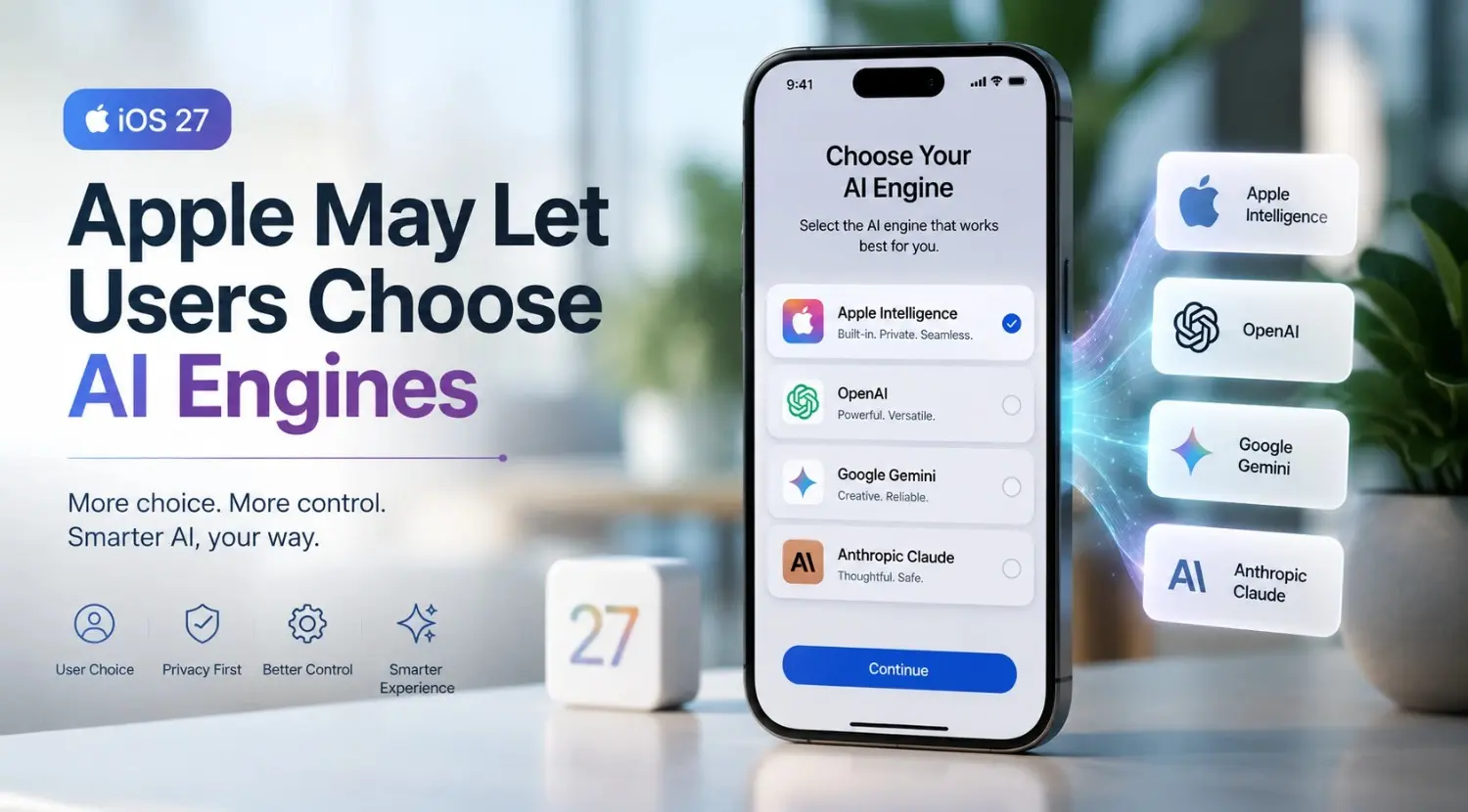
For more than a decade, “Apple” and “open ecosystem” rarely appeared in the same sentence. The company has built one of the most successful businesses in history precisely by keeping tight control over what runs on its devices. So when reports emerged this week that Apple is preparing to let users choose between ChatGPT, Google Gemini, Anthropic’s Claude, and other AI engines to power Siri and Apple Intelligence features in iOS 27, the technology world took notice.
The reported shift, expected to be unveiled at WWDC on June 8 and rolled out with iOS 27, iPadOS 27, and macOS 27 in fall 2026, signals something far bigger than a feature update. It reflects a fundamental rethinking of how Apple plans to compete in the AI era not by building the smartest model, but by building the platform on which the smartest models compete.
Here is everything we know so far, why it matters, and what is still unclear.
The “Extensions” Framework: A Platform-Wide Routing Layer
According to reporting by Bloomberg’s Mark Gurman, Apple is building a new system called “Extensions” that will allow users to select their preferred AI provider directly from the Settings app. In test versions of iOS 27, Apple describes the feature as allowing users to “access generative AI capabilities from installed apps on demand, through Apple Intelligence features such as Siri, Writing Tools, Image Playground and more.”
The mechanics, as reported, are straightforward: install a supported AI app from the App Store, enable it as an Extension, and select it as your preferred model in Settings. From that point, everything routes through your chosen model. Ask Siri to summarise an email, use Writing Tools to rewrite a paragraph, or generate an image in Image Playground — the model you picked handles all of it, not Apple’s own system.
This is the critical distinction. The current ChatGPT integration, which has existed since iOS 18.2 in late 2024, acts as a fallback for queries Siri cannot answer on its own. Extensions is a layer change, not a fallback. The selection is system-wide, not feature-by-feature, which means the choice carries real weight.
Who Could Be on the List
Three AI providers have been explicitly mentioned in reporting:
OpenAI’s ChatGPT remains in the mix, preserving the partnership that has been in place since iOS 18.2.
Google Gemini is being internally tested. Apple has reportedly signed a separate agreement where Gemini also powers native Siri and Apple Intelligence features, meaning Gemini could play two roles as the engine behind Apple’s own next-generation Siri and as a user-selectable Extension.
Anthropic’s Claude is also being tested as a third-party Extension, marking what would be the first deep integration between Apple and Anthropic.
Other providers like xAI’s Grok have been mentioned in reporting as potential candidates, though Apple has not confirmed which providers can participate beyond Gemini and Claude. It is also unclear whether smaller and open-source models could qualify.
A Different Voice for a Different Brain
In one of the more interesting reported details, iOS 27 will reportedly allow users to choose different voices to help distinguish which model is actually responding. The voice used for a pure Siri response could automatically shift to something completely different when the request is handed off to ChatGPT, Gemini, or Claude.
For users, this means transparency about which AI is handling their request a small but meaningful signal in an era when the line between “Siri” and the model behind Siri has become increasingly blurred. It also helps Apple distinguish its in-house Siri from the standalone Gemini app, clearing up any confusion that Siri is simply “powered by Gemini” even when users select Apple’s default experience.
Why Apple Is Opening the Door
Apple is widely seen as playing catch-up in generative AI, even after emphasising privacy, on-device processing, and Private Cloud Compute as the foundation of its approach. Building the best model in every category is an expensive, never-ending race one that Apple does not appear to want to run alone.
Opening Apple Intelligence to rival models lets Apple improve capability faster without needing every model breakthrough to come from Cupertino. The company can focus on what it does best interface design, the privacy layer, device context, app actions, and user controls while letting outside models compete on raw generation quality.
The strategy also reduces risk. AI models improve quickly, and today’s best model may not remain the best for long. A model-choice system gives Apple flexibility. If Gemini becomes stronger in one category, users can choose it. If Claude performs better for writing or reasoning, users can choose that. If OpenAI improves image or voice features, ChatGPT can remain part of the mix. Apple no longer has to bet on a single horse.
A Strategic Shift: Platform Over Product
The deeper story here is what this approach says about Apple’s view of AI. By letting users select their model, Apple is treating its devices as an AI platform rather than an AI product. The model Apple ships is one option. The model the user prefers is another. Both coexist in the same operating system.
This is the same logic that turned the iPhone into the most successful product in history providing the platform, letting third parties compete on top of it, and taking a cut of the value that flows through. With Extensions, Apple is doing for AI what the App Store did for software.
For developers, the implications are significant. AI apps could become more than standalone destinations they could become system extensions. A high-quality AI app installed on iOS could, in theory, handle every Siri query, every Writing Tools request, and every Image Playground prompt across the device.
The Antitrust and Competitive Subtext
The timing and structure of these moves are not happening in a vacuum. Bloomberg Law has noted that the Apple-Gemini deal positions Gemini at important access points within the ecosystem, drawing parallels to the Apple-Google search distribution agreement that a federal court ruled dampened Apple’s incentive to develop its own search capabilities.
The same question now hovers over AI: if Apple has access to a foundation model through Google, will it invest as aggressively in building or partnering with competing ones? The foundation model market currently looks competitive, with ChatGPT, Gemini, and Claude all vying for users, so no clear harm is attributable to any one deal today. But default placement at the system level is the kind of structural advantage whose effects tend to show up later.
By opening Extensions to multiple providers, Apple may be pre-empting some of these antitrust concerns, demonstrating that no single AI partner has exclusive access to its platform.
What Remains Unclear
For all the reporting, several important questions are still unanswered.
Privacy architecture: Apple Intelligence currently runs on-device or through Private Cloud Compute for its own models. It is not yet confirmed whether prompts sent to Claude or Gemini would follow the same privacy architecture, or whether they would be transmitted externally to those providers’ servers.
Data handling disclosure: How Apple plans to surface privacy and data-handling differences among providers at the point of selection is unclear. A user who selects Gemini in Settings may not realise, at the moment of selection, that they are also agreeing to Google’s data practices for those requests.
Subscription gating: Whether premium AI tiers like Claude Pro or Gemini Advanced would be required to unlock full functionality, or whether a free app install would be enough, has not been confirmed. If the better features sit behind paid subscriptions, the real cost of choosing your AI is higher than it looks in Settings.
Voice assistant replacement: None of the reporting suggests users will be able to replace Siri itself with another voice assistant outside of Japan. Conversations may be handled by a different AI model, but the Siri interface remains.
What This Means for the AI Industry
If Extensions ships as reported, the implications extend well beyond Apple. The world’s most valuable consumer hardware company will become a neutral arbiter for AI model choice, putting Google, OpenAI, Anthropic, and others into direct competition for billions of users in the most personal computing environments the iPhone, iPad, and Mac.
For OpenAI, the loss of exclusivity is significant. ChatGPT will no longer be the only third-party model integrated into Apple Intelligence. For Google, Apple’s platform becomes one of the most important distribution channels for Gemini outside its own ecosystem. For Anthropic, Apple integration would be a major leap in mainstream consumer reach for Claude. For smaller AI labs, Extensions could be the most accessible path yet to widespread iOS users.
For users, the most consequential change may be philosophical. AI is no longer something a platform owner picks for you. It is something you pick yourself.
The Bottom Line
Apple’s reported shift toward an open AI ecosystem is one of the most significant strategic moves in the company’s history. By turning model choice into a setting closer to choosing a default browser than downloading a chatbot app, Apple is positioning itself as the platform on which the AI era plays out, rather than just another competitor inside it.
The execution will matter enormously. Set up flows, privacy disclosures, voice handoffs, and pricing transparency will determine whether Extensions feels like genuine empowerment or a confusing handoff to someone else’s servers. The full picture should emerge at WWDC on June 8, when Apple is expected to officially unveil iOS 27.
But the direction is clear. Apple is no longer trying to win AI alone. It is building the stage on which everyone else competes and inviting users to decide who deserves the spotlight.