
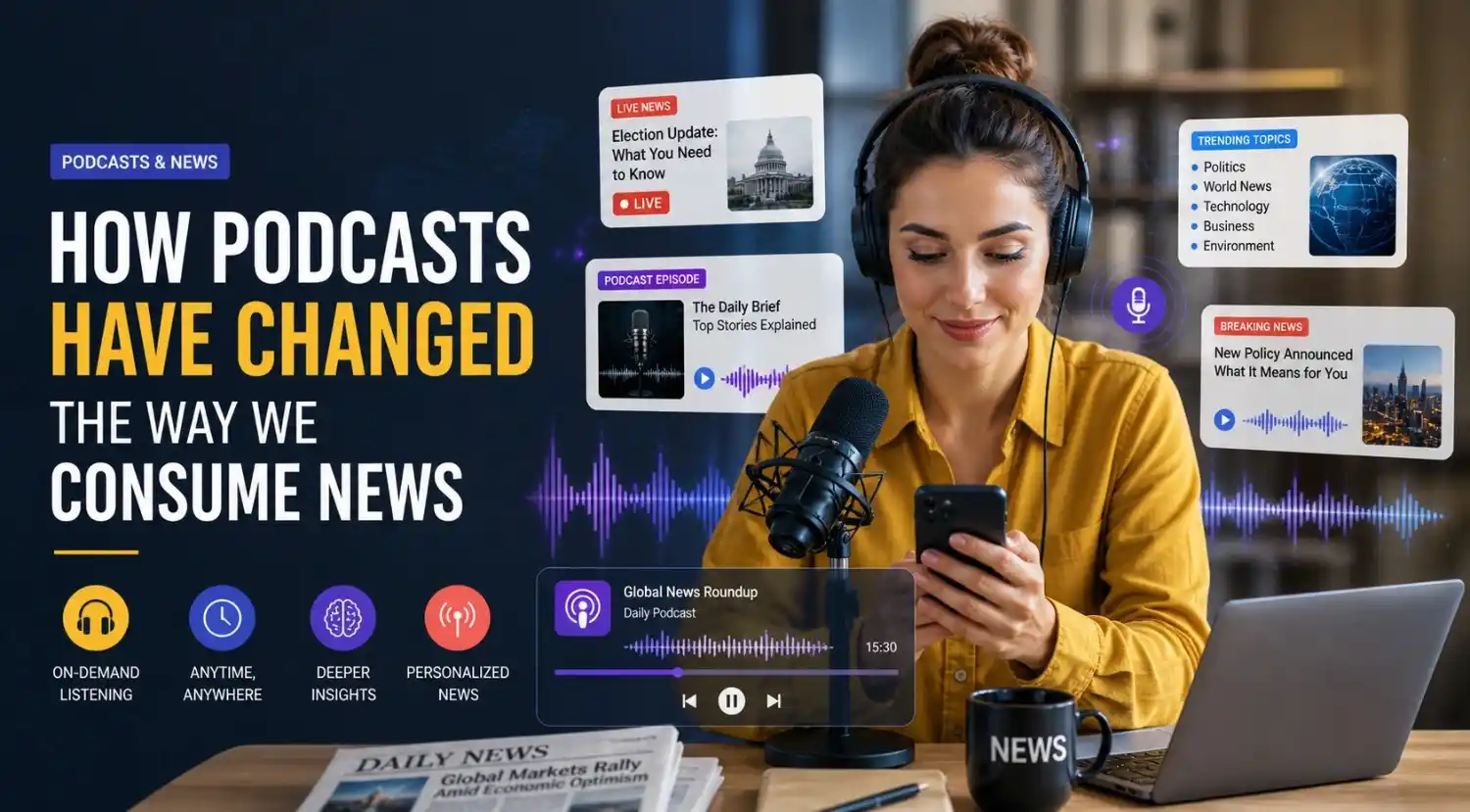
There was a time when news meant a folded newspaper at the breakfast table, a 9 PM TV bulletin, or a quick scan of headlines on a website. The format was rigid, the timing was fixed, and the voice was largely the same—a polished anchor or columnist delivering information from a position of authority. Then came podcasts. Quietly, over the last decade, this audio format has reshaped how millions of people consume news, and the transformation is far deeper than most of us realize.
Podcasts have done something traditional media couldn’t: they’ve made news intimate, on-demand, and deeply personal. Whether you’re commuting, working out, cooking, or walking your dog, you can now listen to in-depth journalism, expert interviews, and political analysis in the gaps of your daily life. In 2025, podcasts are no longer a niche hobby—they’ve become a mainstream news source, especially for younger audiences who never warmed up to print or cable TV.
This article explores how podcasts have changed news consumption, what makes them so powerful, and what this shift means for the future of journalism.
The Rise of Podcasts as a News Medium
Podcasts began as a quirky offshoot of radio in the early 2000s, mostly used for hobbyist content and niche interests. The medium remained small for years until smartphones, streaming apps, and high-speed internet made audio content effortlessly accessible. Then came shows like Serial in 2014, which proved that long-form audio storytelling could capture massive audiences.
By 2020, podcasts had become a billion-dollar industry. By 2025, they’re a default news habit for millions. According to global media reports, daily podcast listenership has crossed hundreds of millions, with news and politics consistently ranking among the most popular categories. Major newspapers like The New York Times, The Washington Post, The Guardian, and The Indian Express have all launched dedicated daily news podcasts, recognizing that audio is where the audience is heading.
What started as a side experiment has become a serious competitor to traditional news formats.
Why Podcasts Resonate So Strongly
Podcasts have grown so rapidly because they tap into something fundamental about how humans prefer to absorb information. Several factors make this medium uniquely powerful for news.
Convenience and Multitasking
The biggest practical advantage is that you don’t need to stop your life to listen. You can absorb a 30-minute deep dive into a news story while driving, exercising, doing chores, or walking. Reading or watching the news demands your full attention; podcasts ask only for your ears. In a world where time is the scarcest resource, this convenience is revolutionary.
Depth That Headlines Can’t Provide
Traditional news, especially TV and social media, has trended toward shorter and shallower coverage. Headlines and 30-second clips dominate. Podcasts offer the opposite—long-form discussions where complex issues can be explored properly. A 45-minute podcast episode can unpack the historical context, multiple viewpoints, and nuanced implications of a story in ways a 600-word article or a news clip simply cannot.
Human Voice and Connection
There’s something uniquely intimate about audio. When a podcast host speaks directly into your ears, often for hours each week, your brain begins to perceive them as a familiar voice—almost a friend. This parasocial connection makes information feel more personal and trustworthy, for better or worse. Listeners develop loyalty to specific hosts, returning week after week not just for content but for the relationship.
Conversational Format
Most news podcasts feature conversations rather than scripted broadcasts. Hosts ask follow-up questions, push back on guests, admit when they don’t know something, and let topics breathe. This format mirrors how people actually discuss news in real life and feels more authentic than the polished, distant tone of traditional media.
On-Demand Access
You’re no longer tied to broadcast schedules. Whether it’s 6 AM or 2 AM, your favorite news podcast is waiting. You can pause, rewind, listen at 1.5x speed, or save episodes for later. This control fundamentally changes the relationship between the listener and the news.
How Podcasts Are Reshaping Journalism
The impact of podcasts on journalism goes beyond just being another distribution channel. They’re changing what kinds of stories get told and how.
A Renaissance of Long-Form Journalism
Podcasts have given long-form storytelling a second life. Investigative series like Serial, S-Town, In the Dark, and The Daily have shown that audiences will happily spend hours with a single complex story if it’s told well. Newsrooms are now investing in narrative audio journalism, often producing investigations specifically designed for the audio format.
Direct-to-Audience Journalism
Independent journalists no longer need a newspaper or TV channel to reach audiences. With a microphone and a podcast hosting account, they can build their own audiences directly. This has empowered niche reporters covering topics like climate, technology, regional politics, or specific industries, who would have struggled to get airtime in traditional media.
Expert and Insider Voices
Podcasts have democratized who gets to speak as a news source. Scientists, economists, doctors, foreign correspondents, and on-the-ground witnesses can share their expertise directly with audiences. This has reduced the filtering that traditional media often imposed and given listeners access to primary sources they would never have heard from before.
Slower, More Reflective News
The 24/7 news cycle of cable TV and Twitter trained audiences to expect constant updates, often at the cost of accuracy and context. Podcasts have introduced a slower, more reflective rhythm—daily or weekly episodes that step back, analyze, and provide perspective. Many listeners find this rhythm healthier and more informative than the constant breaking-news anxiety of traditional channels.
The Shift in News Consumption Habits
Podcasts haven’t just added another option—they’ve actively replaced other news habits for many people, especially younger audiences.
Many millennials and Gen Z listeners report that they get more of their news from podcasts than from newspapers, TV, or news websites. Morning routines have shifted from reading the paper to listening to a daily news podcast during commute or workout. Evening news bulletins are being replaced by analysis podcasts during dinner prep.
Podcasts have also changed which news people pay attention to. Algorithmic feeds on social media show users what’s most outrageous or emotionally charged. Podcast subscriptions, by contrast, are more deliberate—listeners choose specific shows because they trust the editorial perspective. This creates a more curated, intentional news diet, even if it can sometimes lead to ideological bubbles.
International news has particularly benefited from the podcast format. Geopolitical podcasts, conflict explainers, and foreign affairs analysis have audiences far larger than equivalent print or TV coverage typically achieves.
The Concerns and Downsides
It would be naive to celebrate podcasts without acknowledging the problems they’ve created or amplified.
Misinformation and Lack of Editorial Oversight
Anyone can start a podcast. While this democratization has been mostly positive, it also means that podcasts about news, politics, science, and health frequently feature misinformation, conspiracy theories, and uninformed commentary presented with the same authority as professional journalism. Listeners often can’t tell the difference, especially when a charismatic host sounds confident.
Unlike newspapers and broadcasters, most podcasts have no editors, fact-checkers, or accountability structures. A wrong claim made on a podcast with millions of listeners can spread far more widely than a correction ever will.
Echo Chambers and Polarization
Podcast audiences are often highly self-selected. People tend to subscribe to shows that confirm their existing worldviews, creating echo chambers that can deepen political polarization. The intimate, conversational tone of podcasts can also make ideological content feel more like trusted advice than partisan opinion.
The Charisma Problem
Audio is a personality-driven medium. Charismatic hosts can build huge audiences regardless of their actual expertise or accuracy. This has led to situations where popular podcast hosts have more influence on public opinion than experienced journalists or experts, simply because they’re better at sounding compelling.
The Slow Decline of Local News
While national and international podcasts thrive, local news continues to struggle. Podcasts haven’t been a replacement for the loss of local newspapers, which once provided crucial accountability journalism in smaller communities. The rise of podcasts has coincided with—but not solved—the local news crisis.
What This Means for the Future of News
Podcasts aren’t going to replace traditional journalism, but they’ve permanently changed the landscape. We’re moving toward a world where news consumption is fragmented across many formats and voices, with audio playing a central role.
For newsrooms, the message is clear: invest in audio or fall behind. Many legacy outlets are now producing audio versions of major stories, podcast adaptations of investigations, and audio-first projects from the start.
For listeners, the responsibility has shifted. With more sources comes more need for media literacy. Choosing trustworthy podcasts, cross-checking claims, and diversifying your news diet have become essential skills. Following one charismatic host as your sole news source is risky, regardless of how much you trust them.
We’re also likely to see further evolution. AI-generated audio summaries, personalized news podcasts, and interactive audio formats are all on the horizon. The next decade of audio news will likely look very different from today.
Tips for Building a Healthy Podcast News Diet
If podcasts are now part of how you consume news, here are some practical tips to make the most of them while avoiding pitfalls.
Subscribe to a mix of perspectives, not just shows you agree with. Include at least one daily news podcast from a reputable journalism outlet, like The Daily or similar. Add specialized podcasts for topics you care about—technology, business, health, geopolitics. Cross-check important claims you hear, especially on health, finance, and politics. Be wary of podcasts that consistently make sweeping claims, demonize opposing views, or dismiss mainstream sources as untrustworthy. Don’t let podcasts replace reading entirely—long-form articles still offer depth and rigor that audio sometimes lacks.
The goal isn’t to listen to more podcasts. It’s to build a balanced, trustworthy information diet that keeps you genuinely informed.
Final Thoughts
Podcasts have changed news consumption from a passive, scheduled activity into something deeply personal, on-demand, and conversational. They’ve revived long-form journalism, given independent voices a platform, and made complex issues more accessible to ordinary listeners. At the same time, they’ve introduced new challenges around misinformation, polarization, and editorial accountability.
The best response isn’t to choose between podcasts and traditional news. It’s to use both intentionally. Podcasts excel at depth, context, and personality; traditional news excels at breaking developments, fact-checking, and editorial standards. Together, they can give you a richer, more grounded understanding of the world than either could alone.
The way we consume news will keep evolving. But one thing is certain: the era of audio journalism has only just begun, and the voices in your ears are shaping how you see the world more than you might think.